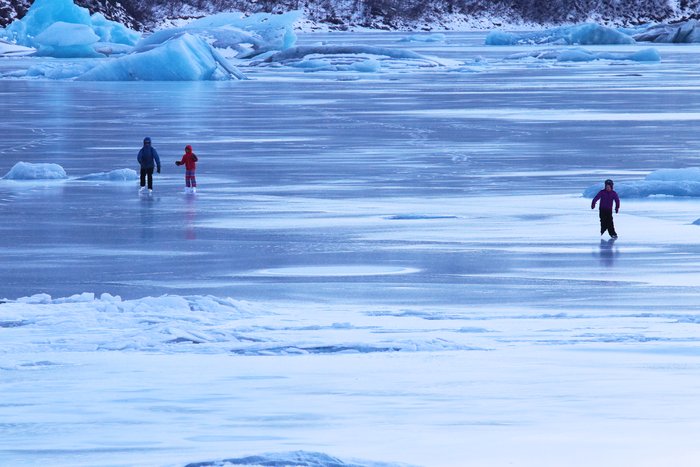
— Why do ice skates slide so well?
In general, a major reason ice is slippery is that the surface of ice remains semi-liquid. Ice skates take advantage of this, gliding on the thin layer of loose water molecules on the surface.
This phenomenon has wide-ranging implications in geology and ice ecology. Not only is the surface of ice not properly bound into a crystal lattice, the same is true for the contact between ice crystals, and the contact between ice and other materials. This becomes especially extreme when the ice is relatively warm, and when salts are present. Whole communities of micro-organisms live in the liquid water between ice crystals in sea ice and other places. Also, this liquid portion can flow, leading to phenomena like frost heaves (in the extreme 100-foot tall pingos in the Arctic), and sorted stones in cold environments.
This also makes ice inclined to rearrange its crystal structure under pressure. In glaciers, what star as microscopic snowflakes cannibalize each other until they grow as large as grapefruit.